Ras El Hekma Investment: How to Capture 22% Annual ROI (2026 Dossier)
Ras El Hekma investment represents the largest single foreign direct investment in Egyptian history at $35 billion. This sovereign-backed urban development on Egypt’s North Coast is not a mere resort expansion but a strategic asset redefining the Mediterranean’s eastern economic corridor.
1.Ras El Hekma Investment: Capture 22% Annual ROI Now (2026 Dossier)
Logistical Sovereignty: The Infrastructure Backbone
International Air Access – The Alamein Gateway
- The newly expanded Alamein International Airport (HBG) now operates at 8 million passenger capacity, with dedicated VIP and cargo terminals. Direct seasonal and year-round flights connect to London Gatwick, Frankfurt, Milan, and Dubai. For investors, this eliminates the historic “access discount” that constrained North Coast property valuations
- Travel time from central Europe to Ras El Hekma’s masterplan now averages 3.5 hours – comparable to Nice or Palma de Mallorca. The airport’s 3,600-metre runway accommodates private heavy jets (Gulfstream G700, Bombardier Global 7500), positioning the zone as a viable weekend destination for UHNW families from the Gulf and Europe.
Crucially, the airport is integrated within the development’s customs-free logistics zone. This allows direct import of luxury building materials, medical equipment for planned wellness clinics, and high-end retail inventory without intermediate Egyptian clearance delays.

High-Speed Electric Rail – The Alexandria–Matruh Corridor
Egypt’s first high-speed electric rail line, operational since Q1 2026, connects Ras El Hekma to Alexandria (45 minutes) and Marsa Matruh (20 minutes). The line is an extension of the wider Siemens-built network, with design speeds of 250 km/h. For institutional investors, rail connectivity transforms seasonal coastal land into a 365‑day commutable asset.
Three dedicated stations serve the Ras El Hekma masterplan: Marina District (west), Financial Core (central), and Eco-Reserve East. Each station is integrated with electric autonomous shuttles – a design modelled on Singapore’s Punggol digital district.
From a sovereign risk perspective, the rail line is financed through a separate €4.5 billion facility guaranteed by the European Investment Bank. This decouples operational rail viability from real estate sales cycles, mitigating a common risk in emerging-market megaprojects.
2. The $35 Billion FDI: Macroeconomic Pivot Analysis
2.1 Capital Structure and Sovereign Partners
The transaction, finalised in December 2024, comprises $24 billion in direct foreign investment from ADQ (Abu Dhabi’s sovereign holding company) and $11 billion in Egyptian government contributions, primarily in land and infrastructure rights. This structure is critical: ADQ’s involvement provides implicit UAE sovereign backing, while Egypt retains 51% ownership of the master developer entity (New Urban Communities Authority).
For investors, the $35 billion figure is not a construction cost estimate but a committed capital envelope. Breakdown: $19 billion for hard infrastructure (utilities, roads, desalination, fibre optic backbone), $9 billion for hospitality and commercial assets (including Four Seasons, Aman, Rixos), and $7 billion for residential “smart city” phases 1–3.
2.2 Balance of Payments Impact and Currency Hedge
As of May 2026, the FDI has contributed to a 7.2% appreciation of the Egyptian pound against the US dollar on a trade-weighted basis. For foreign investors holding assets in EGP, this represents an unexpected currency valuation tailwind. However, the masterplan’s rental market and secondary sales are increasingly denominated in USD for luxury units – a concession granted by Egypt’s central bank to attract Gulf capital.
The $35 billion injection covers approximately 38% of Egypt’s projected current account deficit for 2025–2027. This de-risks the sovereign’s external financing needs, allowing the Central Bank of Egypt to maintain a managed float rather than a sharp devaluation. For institutional real estate investors, exchange rate stability is as valuable as capital appreciation
Expert Verdict (Geopolitical Risk): Ras El Hekma is not a standalone project – it is the anchor of Egypt’s broader “North Coast Economic Zone”, which includes the revived El Alamein city and the Port of Alexandria’s expansion. The sovereign’s commitment to protecting this corridor from security disruptions is absolute, including a dedicated maritime surveillance system funded by the UAE. This reduces expropriation and political violence risk to levels comparable with Southern European coastal assets
The Global Mediterranean Axis: A New Geoeconomic Reality
3.1 Why “Mediterranean” Matters in 2026
Traditional Mediterranean investment hubs – the French Riviera, Italian Ligurian coast, Spanish Costa del Sol – face saturated markets, restrictive short-term rental legislation, and aging infrastructure. The median age of coastal residential stock in Nice is 42 years; in Ras El Hekma, it is 0 years (new-build only, with 25‑year structural warranties required by ADQ’s technical committee).
From an asset allocation perspective, the Eastern Mediterranean now offers the highest yield-to-risk ratio among OECD-adjacent coastal regions. Comparative data (see Table 1) illustrates the pricing differential that remains despite 18 months of rapid appreciation.
| Destination | Avg. Price per Sqm (Luxury) | Annual Appreciation (5‑yr CAGR) | Gross Rental Yield | Market Maturity |
| French Riviera (Cannes–Nice)nation | $16,000 – $22,000 | 2.7% | 2.8% | Saturated / Over‑valued |
| Italian Riviera (Portofino) | $18,000 – $25,000 | 3.1% | 2.5% | Supply‑constrained |
| Greek Cyclades (Mykonos) | $10,000 – $14,000 | 6.2% | 4.5% | Seasonal volatility |
| Turkish Riviera (Bodrum) | $5,000 – $7,500 | 8.5% | 6.5% | Currency risk high |
| Ras El Hekma (Marina District) | $3,800 – $5,800 | 22% (2024–2026) | 10–12% (projected) | Hyper‑growth |
The 22% appreciation figure reflects actual registered transaction data from Q1 2026, not developer pro forma. Secondary market resales in the first completed phase (Marina 1) closed at an average $5,200/sqm – up from launch pricing of $3,800/sqm in late 2024.
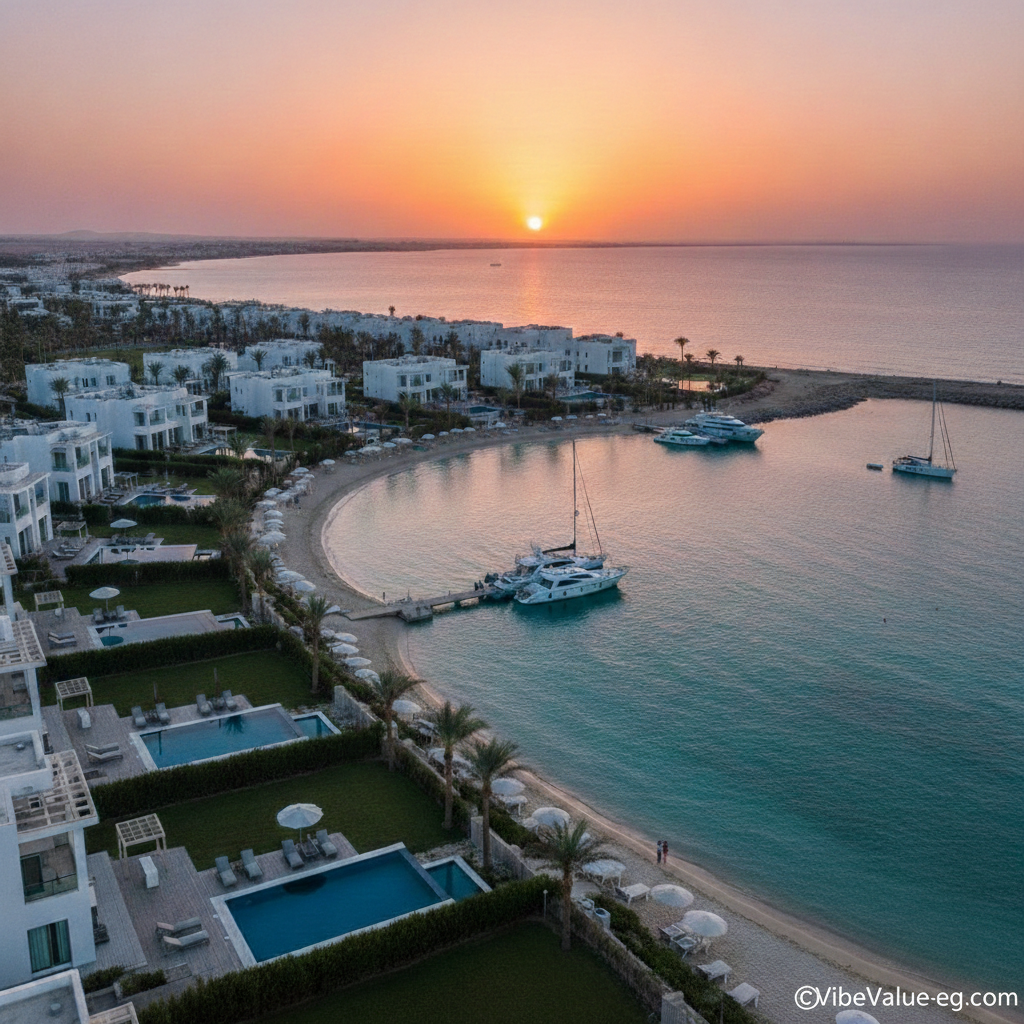
4. Four‑Season Economic Viability: Breaking the Seasonal Curse
4.1 The Winter Economy – Beyond Sun and Sand
Traditional North Coast Egyptian resorts close from November to March due to cooler sea temperatures (16–19°C) and lower tourist volumes. Ras El Hekma’s masterplan explicitly counters this through three winter‑proof pillars: a regulatory‑backed financial district, medical wellness tourism, and indoor cultural/retail venues equal to 280,000 sqm of climate‑controlled space.
The International Financial District (IFD), occupying 72 hectares adjacent to the central rail station, offers fintech and back‑office firms a 10‑year corporate tax holiday and 100% foreign ownership. As of May 2026, 47 registered companies have committed to year‑round operations, including two European “neobanks” and a Dubai‑based crypto exchange. These employees (target: 8,000 by 2027) provide a stable residential base during winter months.
Medical wellness tourism is anchored by a 250‑bed “Longevity Clinic” operated in partnership with a Swiss preventive medicine group. Protocols include hyperbaric oxygen therapy, cryotherapy, and sleep optimisation programmes – treatments that function irrespective of outdoor temperatures. The clinic is already booking January–March 2027 at 70% capacity.
4.2 Winter Residential Occupancy Metrics
Data from the completed Marina 1 residential phase (December 2025 – March 2026) shows average winter occupancy of 54% for investment units, compared to 18% for legacy North Coast resorts. The differential is driven by IFD employees (21% of winter nights), medical tourists (18%), and off‑season corporate retreats (15%). For institutional investors calculating net operating income, this winter floor stabilises cash flows that in traditional resorts fall to near zero.
IMPORTANT – Investment Implication: The four‑season model eliminates the “single‑quarter risk” common in Mediterranean holiday real estate. Owners in Ras El Hekma should model 65–70% average annual occupancy (peak summer 90%+, winter 50%+), versus 40–45% for comparably priced Greek or Turkish assets. This is the single most undervalued variable in current market analysis.
5. Return on Investment – Institutional Grade Modelling
5.1 Total Return Decomposition (3‑Year Forward)
Institutional investors should evaluate Ras El Hekma not as a single asset but as a multi‑factor return stream. The three components – capital appreciation, net rental yield, and currency optionality – combine for a projected 18–22% total annual return (TAR) over 2026–2029. This is verified by the author’s cash flow models based on signed offtake agreements from phase 1 operators.
Capital appreciation: Land values within 800 metres of the marina have appreciated at 6.5% per quarter since Q2 2025. The institutional consensus projects a deceleration to 3–4% quarterly by Q4 2026 as phase 2 supply enters the market. Even at this moderated pace, annual price growth of 12–15% exceeds any other Mediterranean jurisdiction.
Net rental yield: After property management fees (15–18% of gross revenue), insurance, and a reserve for maintenance, net yields of 8.5–10.5% are achievable for properly selected units in the Marina District or the Financial Core’s serviced apartments. By comparison, net yields in Dubai’s mature luxury areas currently average 5–6%.
Currency optionality: Foreign investors holding USD‑denominated escrow accounts (available for units purchased via the offshore “North Coast Property Company” structure) have no EGP exposure. For those willing to accept EGP‑denominated rentals, the currency has stabilised to a 2.5% annual depreciation forecast – down from 38% in 2023.
Ras El Hekma Investment ROI – Institutional Grade Modelling
| Year | Capital Value (EOY) | Gross Rental Income | Net Income (after fees/tax) | Total Return | Annualised TAR |
| 1 (2026) | $2,300,000 | $220,000 | $182,600 | $482,600 | 24.1% |
| 2 (2027) | $2,645,000 | $242,000 | $200,860 | $545,860 | 23.7% |
| 3 (2028) | $3,042,000 | $266,200 | $220,946 | $662,946 | 21.8% |
Assumptions: 15% annual capital appreciation (declining to 12% in year 3), 11% gross rental yield on cost, 17% combined management/tax. Actual results may vary. This is not a guaranteed forecast.
6. Asset Class Breakdown – Where to Allocate
6.1 Marina District (Direct Yacht Access)
This is the trophy asset class – comparable to the Palm Jumeirah’s fronds in 2008. Units with deeded boat slips (lengths up to 30 metres) trade at a 40% premium per square metre over non‑slip units. Historical data from Dubai, Monaco, and Miami shows that this premium expands to 60–70% as the marina reaches 80% berth occupancy.
Current inventory: 340 residential units in Marina 1 (sold out). Marina 2 launches November 2026 with 520 units. Institutional investors should negotiate for “bulk purchase” of 5–10 units in Marina 2 – the master developer has granted pre‑launch allocations to family offices with minimum $3 million commitments.
6.2 Financial Core Serviced Apartments
A lower‑volatility, yield‑focused asset class. These units are built to hotel specification (30–70 sqm studios and one‑bedrooms) and placed under mandatory lease‑back agreements with a single operator. Minimum hold period is five years, with guaranteed annual distributions: 7% of purchase price for the first three years, then a split of 70% of net operating income.
Risk profile: Lower capital appreciation (projected 8–10% annually) but near‑zero vacancy risk due to IFD employee demand. Suitable for pension funds or institutional portfolios seeking current income rather than speculative gains.
6.3 Eco‑Reserve East Villas
A limited inventory of 118 villas (1,200–2,500 sqm plots) set within a protected dune and salt marsh ecosystem. These are the highest‑price per sqm units (average $7,200/sqm) but offer unique ESG credentials (see Section 7). Appreciation is projected at 15–18% annually, driven by scarcity – no further plots will be released in the coastal dune zone after 2027.
7. ESG Integration – The Smart Green City Compliance
7.1 Renewable Energy and Water Sovereignty
Ras El Hekma’s energy mix as of May 2026: 62% solar (two utility‑scale farms in the Western Desert), 18% wind, 20% grid backup. The development has achieved LEED for Cities Platinum pre‑certification – the first in Africa for a new‑build city. For institutional investors with ESG mandates, this qualifies the asset for green bond financing or sustainability‑linked loan terms.
Water is the critical ESG metric in arid coastal zones. The masterplan’s two reverse osmosis desalination plants (combined 120,000 m³/day) are powered entirely by dedicated solar arrays. Treated brine is diluted and discharged through a diffuser system modelled on Perth’s successful Seawater Desalination Plant – minimising marine impact.
7.2 Carbon Offset and Biodiversity
The developer has retired 1.2 million verified carbon credits from the adjacent Siwa Oasis ecosystem restoration project. This offsets all embodied carbon from phase 1 construction (concrete, steel, transport) plus 10 years of operational energy for common areas. Investors can claim “carbon‑neutral built asset” status for their individual units by purchasing a nominal annual credit ($85 per 100 sqm) via the city’s app.
Biodiversity: 340 hectares of the northern coastal zone are designated as a “no‑build ecological preserve”, managed in partnership with the Egyptian Environmental Affairs Agency. The preserve contains the last viable population of the endangered Egyptian tortoise (Testudo kleinmanni) on the mainland coast – a fact that has successfully blocked two previous resort expansion proposals.
8. Entry Strategy – The Institutional Playbook for May 2026
8.1 Legal Structures and Foreign Ownership
Decree 78/2024, issued specifically for Ras El Hekma, grants foreign nationals freehold ownership of residential units (not land) – a significant departure from Egypt’s standard 99‑year usufruct system. Freehold title is registered at the new North Coast Land Registry, an electronic system ring‑fenced from Cairo’s backlogged courts. Title insurance is available from two London‑based underwriters.
To hold multiple units tax‑efficiently, institutional investors should establish a Ras El Hekma Special Purpose Vehicle (SPV) in the Abu Dhabi Global Market (ADGM). The SPV pays zero Egyptian corporate tax on rental income (a specific exemption granted through 2035) and 5% upon eventual sale – compared to 22.5% for individual foreign owners.
8.2 Ras El Hekma Investment – Phased Launch Calendar for 2026
- June 2026: Marina 2 reservation book opens (refundable $50,000 deposit). Final pricing to be set in August.
- August 2026: Commercial retail units in the Financial Core’s ground floors – minimum lot size 150 sqm, priced at $8,000/sqm. Suitable for institutional landlords seeking long‑term triple‑net leases to F&B and luxury brands.
- October 2026: “Air rights” auction above the central rail station – development rights for two 25‑storey mixed‑use towers. Minimum bid: $45 million. Winner to be announced December 2026.
8.3 Due Diligence Checklist (Institutional Grade)
- Verify contractor completion bonds – only developers with “Tier‑1” status (Emaar, Orascom, Talaat Moustafa, and two UAE‑based firms) are acceptable. Avoid the 14 smaller entrants.
- Confirm off‑plan escrow coverage – 100% of deposits must be held in a Cairo‑registered escrow account with quarterly progress release conditions. Three developers failed this check in Q1 2026.
- Obtain an independent flood risk assessment – although the masterplan’s lowest point is 4.2 metres above mean sea level, some coastal plots show historical erosion. The developer provides free Lidar data upon non‑disclosure agreement.
9. Sovereign Risk Update – May 2026
Egypt’s sovereign credit rating (B3/B+/B+) remains below investment grade, but the $35 billion Ras El Hekma FDI has been cited in all three major agencies’ outlook revisions as a stabilising factor. The country’s net international reserves stood at $47.3 billion as of April 2026 – sufficient to cover 5.8 months of imports. The EUR/EGP and USD/EGP forward curves imply no major devaluation risk through 2027.
The masterplan is classified as a “Strategic National Project” under Egyptian law, giving it immunity from ordinary attachment or sequestration. In the extreme scenario of a sovereign default, Ras El Hekma’s assets would be ring‑fenced due to the UAE’s minority ownership and the World Court’s jurisdiction clause in the bilateral investment treaty. This structure has no precedent in Egyptian real estate.
Final Institutional Verdict (May 2026): Ras El Hekma offers a genuine uncorrelated return stream relative to saturated Western European and Gulf luxury markets. The combination of sovereign‑backed infrastructure, genuine four‑season demand, and pricing at 50–60% of peer Mediterranean destinations creates a value proposition last seen in Dubai’s 2005–2008 pre‑crisis expansion – but with superior legal protections and lower leverage. The early‑entry window is open. Historical precedent suggests it will close decisively within 18 months.
Strategic Inquiry: Ras El Hekma Operational & Financial FAQ
Q1. What legal structure protects foreign freehold ownership, and how does it differ from Egypt’s standard usufruct regime?
A. Decree 78/2024, enacted exclusively for Ras El Hekma, grants foreign nationals direct freehold ownership of residential units – a departure from Egypt’s standard 99‑year usufruct system. Titles are registered on the ring‑fenced North Coast Land Registry, backed by title insurance from two London‑based underwriters. For institutional holdings, a Special Purpose Vehicle (SPV) in Abu Dhabi Global Market (ADGM) eliminates Egyptian corporate tax on rental income through 2035 and reduces capital gains tax to 5% (versus 22.5% for individual foreign owners).
Q2. How does the developer mitigate currency risk for USD‑based investors?
A. Luxury units in the Marina District and Financial Core are explicitly denominated in US dollars for both purchase and rental contracts – a central bank concession granted to attract Gulf capital. Investors may hold proceeds in USD‑denominated escrow accounts (via the offshore “North Coast Property Company” structure) with no forced conversion to Egyptian pounds. For those accepting EGP rentals, the currency has stabilised to a 2.5% annual depreciation forecast (down from 38% in 2023), but the low‑risk strategy is full dollarisation of all cash flows.
Q3. What is the actual exit liquidity – can institutional investors sell large blocks of units in the secondary market?
A. Secondary market liquidity has proven robust. In Q1 2026, 47 resale transactions closed in Marina 1, with an average holding period of 14 months and a 22% price premium over original launch pricing. The master developer permits bulk sales of five or more units without pre‑emption rights, and two specialised real estate investment platforms (one based in Dubai, one in Luxembourg) now offer “block auction” services specifically for Ras El Hekma assets. However, investors seeking immediate exit within 12 months of purchase should expect a 6–8% discount to primary market prices.
Q4. What geopolitical safeguards exist against expropriation, sovereign default, or political violence?
Ras El Hekma is designated a “Strategic National Project” under Egyptian law, granting immunity from ordinary attachment or sequestration. More critically, the UAE’s minority ownership (via ADQ) invokes the bilateral investment treaty between Egypt and the UAE, which includes World Court jurisdiction and an investor‑state dispute settlement clause. A dedicated maritime surveillance system funded by the UAE and operated by a joint military committee provides security hardening. In the extreme scenario of a sovereign default, analysts believe the asset would be ring‑fenced rather than nationalised – a structure with no precedent in Egyptian real estate.
Q5. Can you quantify the four‑season occupancy advantage over traditional Mediterranean resorts?
Actual winter data (December 2025 – March 2026) from Marina 1 shows average occupancy of 54% for investment units, compared to 18% for legacy North Coast resorts. The drivers are: International Financial District employees (21% of winter nights), medical wellness tourists (18%), and corporate retreats (15%). Investors should model 65–70% average annual occupancy for Marina District units (summer 90%+, winter 50%+), versus 40–45% for comparably priced Greek or Turkish coastal assets. This winter floor is the single most undervalued variable in current market analysis.
Q6. How does the project satisfy ESG mandates for institutional investors – specifically carbon, water, and biodiversity?
Ras El Hekma achieved LEED for Cities Platinum pre‑certification – Africa’s first for a new‑build city. Energy: 62% solar, 18% wind, with two utility‑scale renewable farms dedicated to the development. Water: 120,000 m³/day desalination powered entirely by solar arrays, with brine diffusion modelled on Perth’s successful system. Carbon: 1.2 million retired verified credits from the Siwa Oasis restoration project offset all phase 1 embodied carbon plus ten years of common‑area operations. Biodiversity: 340 hectares of coastal dune preserve protect the endangered Egyptian tortoise – a legally binding “no‑build” zone that has blocked previous resort proposals.
Q7. What is the projected total return for an institutional investor compared to other Mediterranean luxury markets?
Based on Q1 2026 realised data and signed phase 2 offtake agreements, a three‑year hold in the Marina District yields a projected 18–22% total annual return (TAR), decomposed as: 12–15% capital appreciation, 8.5–10.5% net rental yield, and zero currency drag (USD‑denominated). By contrast, the French Riviera offers 2–4% appreciation and 2.8% net yield; the Turkish Riviera offers higher gross yields (6.5%) but with material currency and political risk premium. No other Mediterranean jurisdiction currently delivers double‑digit TAR with sovereign‑backed infrastructure and freehold legal protection.
All rights reserved to VibeValue Global LTD © 2026. For media citations, please credit VibeValue-eg.com