7 Massive Reasons Why Gargoub Port is International Global Hub
The Gargoub International Port stands as the cornerstone of Egypt’s modern maritime strategy, representing a monumental $10 billion investment in global logistics. As the primary Mediterranean gateway to the African continent.
Gargoub International Port offers an unparalleled advantage multidimensional economic engine designed to serve as the primary gateway for trade between the European Union, the Mediterranean, and the burgeoning markets of Sub-Saharan Africa
As of March 2026, the Egyptian government’s commitment to privatising management and expanding the Gargoub Special Economic Zone (GSEZ) has caught the attention of institutional heavyweights.
With the Egyptian Pound (EGP) stabilizing at approximately $1 = 51.88 L.E., the entry valuation for foreign direct investment (FDI) presents a rare “buy-low” window for infrastructure-focused portfolios.
Strategic Location: The Pivot of Global Supply Chains
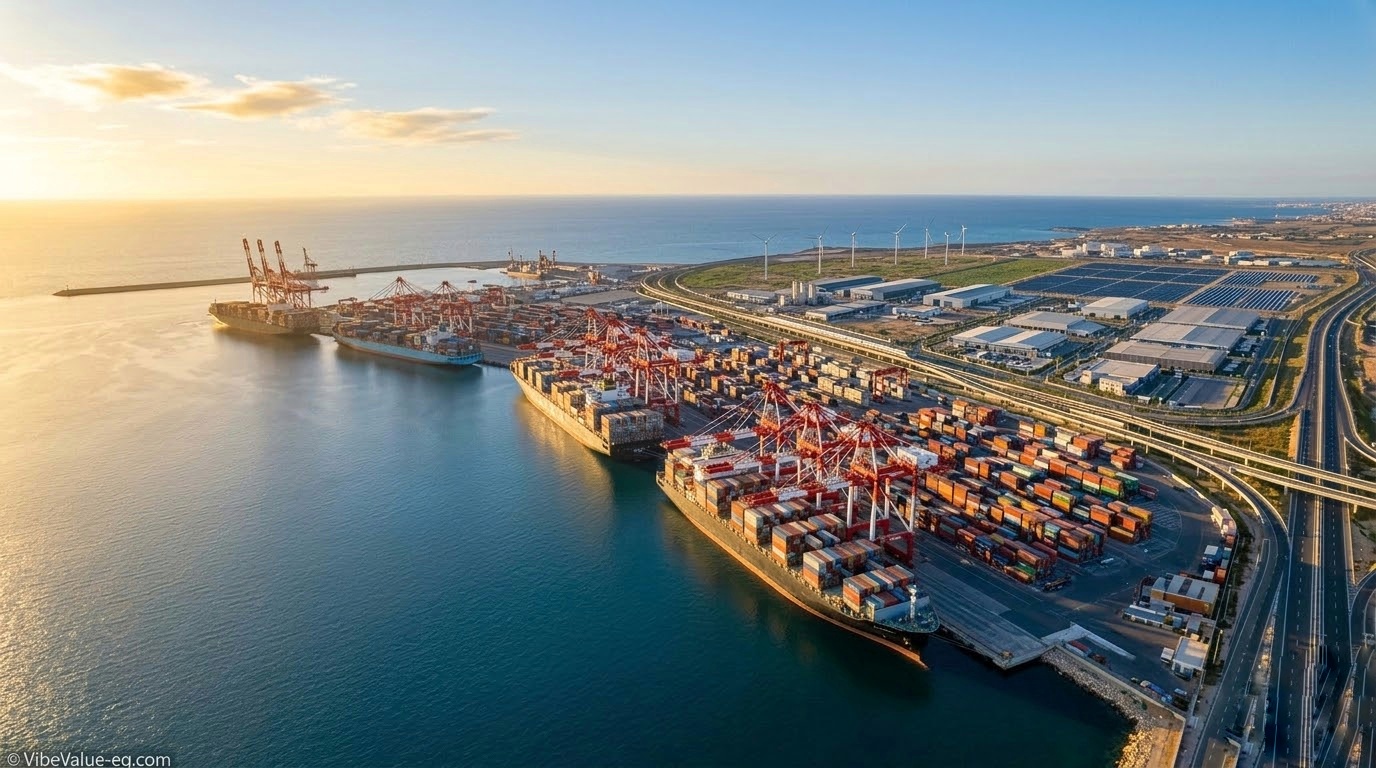
Unlike traditional ports, Gargoub offers a unique deep-water advantage (depths of up to 18-22 metres), allowing it to host the world’s largest Triple-E class container vessels.
This capability positions Gargoub International Port as a formidable competitor to established hubs like Tangier-Med and Valencia.
The port is the cornerstone of the “Jarjoub-Salloum” logistics corridor, which integrates:
- High-Speed Rail Links: Connecting the Mediterranean to the Red Sea.
- The Cairo-Cape Town Highway: Facilitating land-based freight into the heart of Africa.
- Industrial Clusters: 402,000 feddans of dedicated land for green hydrogen, logistics, and manufacturing.
Financial Analysis and ROI Projections for Gargoub International Port
Investment in Gargoub International Port is supported by robust sovereign guarantees and a shift toward Public-Private Partnerships (PPP).
Recent reports from Morgan Stanley and Goldman Sachs highlight Egypt’s “NextGen” emerging market status, noting that the stabilization of the FX market has significantly de-risked long-term infrastructure assets.
Investment Breakdown and ROI Table
| Investment Segment | Est. Capital Outlay (USD) | Est. Capital Outlay (L.E.) | Projected Annual ROI | Concession Period |
| Container Terminals | $2.5 Billion | 129.7 Billion L.E. | 14% – 18% | 30 – 50 Years |
| Green Hydrogen Hub | $4.0 Billion | 207.5 Billion L.E. | 12% – 15% | 25 Years |
| Logistics & Warehousing | $1.2 Billion | 62.2 Billion L.E. | 20%+ | 20 Years |
| Special Economic Zone | $2.3 Billion | 119.3 Billion L.E. | 16% | Perpetual/Lease |
Expert Insight: The convergence of the Suez Canal’s dominance and Gargoub’s Mediterranean reach creates a “double-lock” on regional trade.
Investors should focus on the Green Hydrogen sector within Gargoub, as the EU’s Carbon Border Adjustment Mechanism (CBAM) makes Egyptian-produced clean energy highly competitive for European off-takers.
Global Banking Sentiment on Gargoub International Port
According to the Morgan Stanley 2026 Outlook, Egypt is positioned for a “rolling recovery,” with the transport and storage sector expected to lead GDP growth.
Analysts at Goldman Sachs have noted that the “Strategic Long-Term Partnership” between Egypt and global powers (including China and the EU) provides a “sturdy growth” cushion of 2.8% to 3.5% for 2026.
Gargoub International Port is frequently cited as a “Real Asset” opportunity. In an era of “Capped Real Rates,” institutional investors are moving away from volatile tech stocks toward high-moat infrastructure projects like Gargoub that offer inflation-indexed returns via USD-denominated port fees.
Infrastructure and Technical Capacity
The engineering of Gargoub follows a “Green Port” philosophy. It includes:
- Automated Terminals: Utilizing AI-driven logistics for 100% transparency.
- Multipurpose Berths: Over 14 kilometers of quay walls capable of handling bulk, liquid, and containerized cargo.
- Special Economic Zone (SEZ): Under Law No. 83 of 2002, the zone offers zero customs duties on production inputs and significant corporate tax incentives.
Timeline of Development
| Phase | Milestone | Completion/Status |
| Phase 1 | Primary Breakwaters & Container Terminal 1 | Completed (2024-2025) |
| Phase 2 | Green Hydrogen Production Facilities | Under Construction (Target 2027) |
| Phase 3 | Full SEZ Integration & High-Speed Rail Connection | Planned (2028-2030) |
The African Gateway: Why Gargoub Matters for 2026
The African Continental Free Trade Area (AfCFTA) is the largest free trade area in the world by the number of participating countries. Gargoub International Port acts as the northern spout for this massive market.
By bypassing the congested Suez Canal for Mediterranean-specific trade, Gargoub reduces transit times to Southern Europe by 24-48 hours.
This efficiency is not just a logistical win; it is a financial one. Shorter lead times mean lower insurance premiums and faster capital rotation for global exporters.
FAQ: Strategic Facts About Gargoub International Port
1. What is the total investment size of Gargoub International Port?
The total estimated investment for the port and its surrounding economic zone is approximately $10 billion, funded through a mix of state investment, foreign FDI, and international loans.
2. Can foreign investors own companies in the Gargoub SEZ?
Yes, under the Special Economic Zones Law, 100% foreign ownership is permitted, along with incentives for profit repatriation and streamlined “one-stop-shop” licensing.
3. How does Gargoub Port benefit the Green Hydrogen industry?
Gargoub is designated as a primary production and export hub for Green Hydrogen due to its proximity to wind and solar-rich regions in Western Egypt and its direct access to European markets.
4. What are the tax incentives for investing in Gargoub?
Projects within the SEZ benefit from 0% customs duties on equipment and raw materials, as well as competitive corporate tax rates designed to stimulate export-oriented manufacturing.
5. How is the Gargoub Port connected to the rest of Egypt?
The port is linked via the new coastal highway, the existing national rail network, and the upcoming high-speed electric rail that connects the Mediterranean coast to the Red Sea ports.
All rights reserved to VibeValue Global LTD © 2026. For media citations, please credit VibeValue-eg.com